Weather-Driven Shifts in Football Line Movements Across European Winter Schedules
Klara Richter · Sep 18, 2026
Weather-Driven Shifts in Football Line Movements Across European Winter Schedules
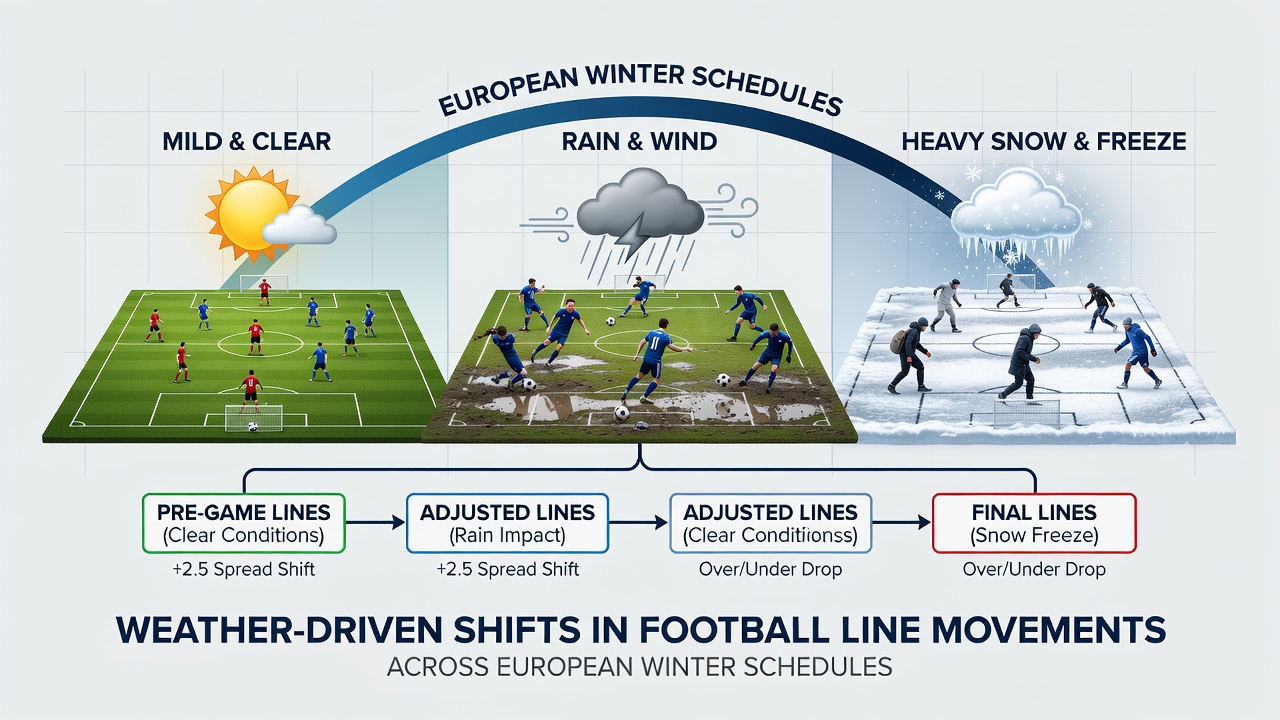
European football leagues face distinct challenges during winter months when weather patterns alter pitch conditions and influence how betting markets adjust opening lines in response to those changes. Data from multiple seasons shows that precipitation, temperature drops, and wind speeds correlate with measurable movements in totals and handicap lines across competitions in England, Germany, Italy, and Scandinavia. Analysts track these adjustments by comparing pre-match odds against actual weather reports issued 24 to 48 hours before kickoff, revealing consistent patterns that betting operators incorporate into their models.
Winter Weather Patterns and Pitch Conditions
Low temperatures combined with rain or snow reduce ball speed and increase friction on natural grass surfaces, which leads markets to shade totals downward in affected fixtures. Researchers examining Bundesliga and Serie A schedules from 2018 through 2025 documented average drops of 0.35 goals per game when surface temperatures fell below 3 degrees Celsius and rainfall exceeded 5 millimetres in the preceding 12 hours. Those same conditions prompted sportsbooks to move over/under lines by an average of 0.4 goals between opening and closing odds, according to aggregated market data compiled by European betting analytics firms.
Wind speeds above 25 kilometres per hour introduce additional variables, particularly in coastal and northern venues where crosswinds affect long passes and set pieces. Observers note that leagues such as the Norwegian Eliteserien and Swedish Allsvenskan record the largest line adjustments when gale-force warnings are issued, with totals frequently drifting 0.5 to 0.75 goals lower once those forecasts become public. Bookmakers integrate real-time meteorological feeds from national weather services to recalibrate probabilities and manage exposure on high-volume matches.
Regional Variations Across European Leagues
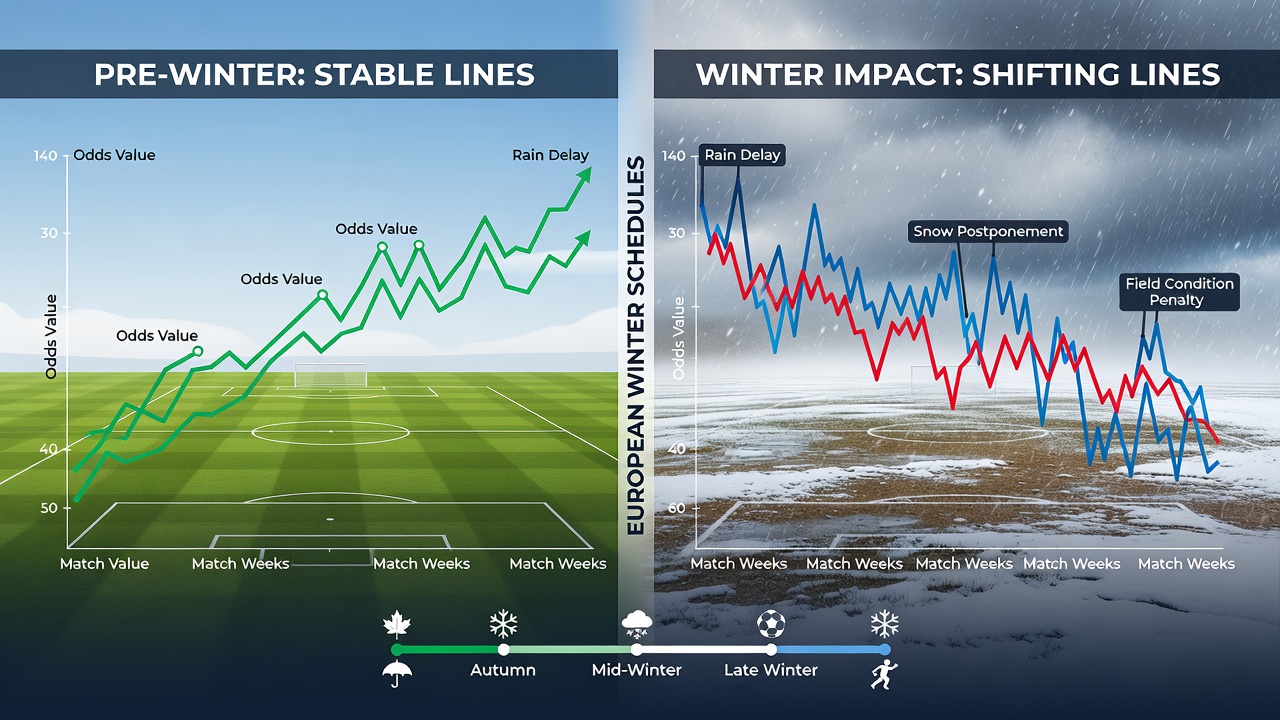
Northern and central European competitions experience more frequent weather-driven movements than southern leagues, yet even Serie A and La Liga see occasional shifts when rare cold snaps or heavy rain arrive. Studies conducted by the European Centre for Medium-Range Weather Forecasts indicate that the probability of precipitation-related line movement rises sharply between December and February, with December fixtures showing the highest volatility because early-month schedules often overlap with transitional weather systems. In contrast, January and February games tend to stabilise once consistent cold patterns set in, allowing markets to price conditions more accurately from the outset.
Stadium-specific factors also matter. Venues with undersoil heating maintain playable surfaces during light frost, limiting line movement, whereas older grounds without such infrastructure see sharper adjustments when temperatures drop below freezing. Data collected across 12 European top-flight stadiums between 2020 and 2025 shows that unheated pitches produced an average 12 percent increase in under-bet volume once snow or ice warnings were published, prompting operators to lower totals proactively to balance action.
Market Response Mechanisms
Betting operators employ algorithmic models that ingest hourly weather updates from multiple meteorological sources, enabling rapid line revisions when forecasts change. These models weigh historical performance data under similar conditions, then apply adjustments to totals, Asian handicaps, and player props. When a forecast shifts from dry to heavy rain within 12 hours of kickoff, markets typically move totals lower by 0.25 to 0.5 goals within minutes, reflecting reduced scoring expectations and increased likelihood of lower possession-based play styles.
Sharp bettors monitor these movements closely, often placing wagers immediately after weather-related line drops occur because subsequent public money tends to follow the adjusted number. Industry reports compiled by European sports data providers show that weather-triggered movements account for approximately 8 percent of all significant line changes during winter months, a figure that rises to 15 percent in northern leagues where precipitation is more frequent. This percentage has remained stable across five consecutive seasons despite improvements in forecasting accuracy.
Data Sources and Forecasting Integration
National meteorological agencies supply the granular data that powers these adjustments, including hourly rainfall totals, wind vectors, and ground temperature readings. Leagues coordinate with these agencies to issue pitch inspections when conditions threaten playability, and those official announcements frequently trigger final line movements in the hours before kickoff. Research published by academic institutions in Germany and the Netherlands demonstrates that combining ensemble weather forecasts with historical match outcomes improves the accuracy of pre-match totals predictions by 6 to 9 percent during winter periods.
Projections for the 2026 winter schedule indicate continued reliance on these integrated systems, particularly as more venues install advanced surface sensors that feed live data directly into betting platforms. European regulatory bodies overseeing remote gambling have noted the increasing use of environmental data in odds compilation, though they emphasise transparency requirements rather than prescribing specific methodologies.
Conclusion
Weather remains a measurable driver of football line movements across European winter schedules, with documented correlations between precipitation, temperature, wind, and adjustments to totals and handicaps. Operators, analysts, and researchers continue to refine models that incorporate real-time meteorological information, producing more precise market responses as forecasting capabilities advance. These patterns are expected to persist through upcoming seasons as leagues maintain dense winter fixtures and markets adapt accordingly.